 |
The Nature of Prophecy ...continued
Grace and Faith in Prophecy
There are two boundaries the bible sets for the use
of spiritual gifts, in that the person exercising the gift should not go beyond
divine grace or their own faith. It is important that the prophet is not caught
up with the emotion of the moment or the sound of his or her own voice
Romans 12:6 "We have different gifts,
according to the grace given us. If a man's gift is prophesying, let him use it
in proportion to his faith."
We have our Gifts first by the grace given us and second should
use them in proportion to our faith. Paul has already said in Romans 12:3 that
we should not think more highly of ourselves that we ought. Therefore we can
assume that we have a certain degree in appreciating the grace given and a
certain level of faith. We should therefore recognise the God given boundaries
to our use of spiritual gifts especially prophecy
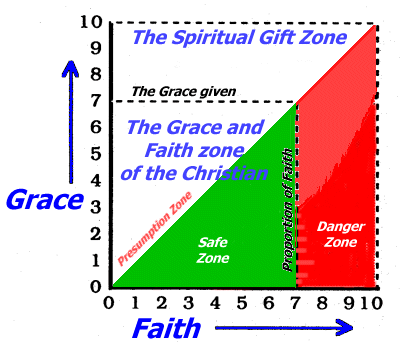
We should therefore allow the Holy Spirit to increase our faith
and develop our appreciation of the grace given us.
Everett F. Harrison in "The Expositor's Bible Commentary; Romans"
volume 10, (19) says of this verse:
"6-8 "We have different gifts." Paul is not
referring to gifts in the natural realm, but to those functions made possible
by a specific enablement of the Holy Spirit granted to believers. The gift does
not contradict what God has bestowed in the natural order and, though it may
even build on the natural gift, it must not be confused with the latter.
Variety in the gifts should be understood from the standpoint of the
needs of the Christian community, which are many, as well as from the
desirability of giving every believer a share in ministry. With his eye still
on the danger of pride, Paul reminds his readers that these new capacities for
service are not native to those who exercise them but come from divine grace.
Every time he delves into this subject he is careful to make this clear (I
Corinthians12: 6; Ephesians 4:7 cf. I Peter 4:10).
Although he has
spoken of different gilts, Paul does not proceed to give anything like an
exhaustive list (cf. I Corinthians 12:27, 28). He seems more intent on
emphasizing the need for exercising the gifts and for exercising them in the
right way - "in proportion to [one's] faith." He uses this expression only in
connection with prophesying, but there is no reason to suppose it is not
intended to apply to the other items as well.
What is meant by "in
proportion to his faith" (v.6)? Theologians have tended to favour the
translation "according to the analogy of the faith" (transliterating the Greek
word 'analogia' and stressing the definite article before "faith"). Upon this
construction is built the Reformed principle that all parts of Scripture must
be interpreted in conformity to the rest. This is a valid principle but hardly
germane to this context.
Another view of the matter, held by Godet (in
loc.), for example, understands the phrase as referring to the hearers rather
than to the prophets, so that, in framing the messages given them, those who
speak should consider the stage of development attained by their audience. This
view, too, may have merit, but against it is the fact that in this passage it
is not spiritual gifts that are being treated for the edification of the
hearers, as in I Corinthians 14, but the proprieties that should govern those
who use the gifts.
The most satisfactory explanation is that "faith"
retains the subjective force it has in v.3 and that the whole phrase has the
same thrust as "measure of faith" there. A prophet is not to be governed by his
emotions (I Corinthians 14:32) or by his love of speaking (I Corinthians 14:30)
but by entire dependence on the Spirit of God.
Paul does not give a
definition of prophecy here, but if we are to judge from the earlier reference
to it in I Corinthians 14:3, 31, the nature of the gift is not primarily
prediction but the communication of revealed truth that will both convict and
build up the hearers."
 Previous Next Previous Next

|


